
V-Reversal
Patterns · Reversal Patterns
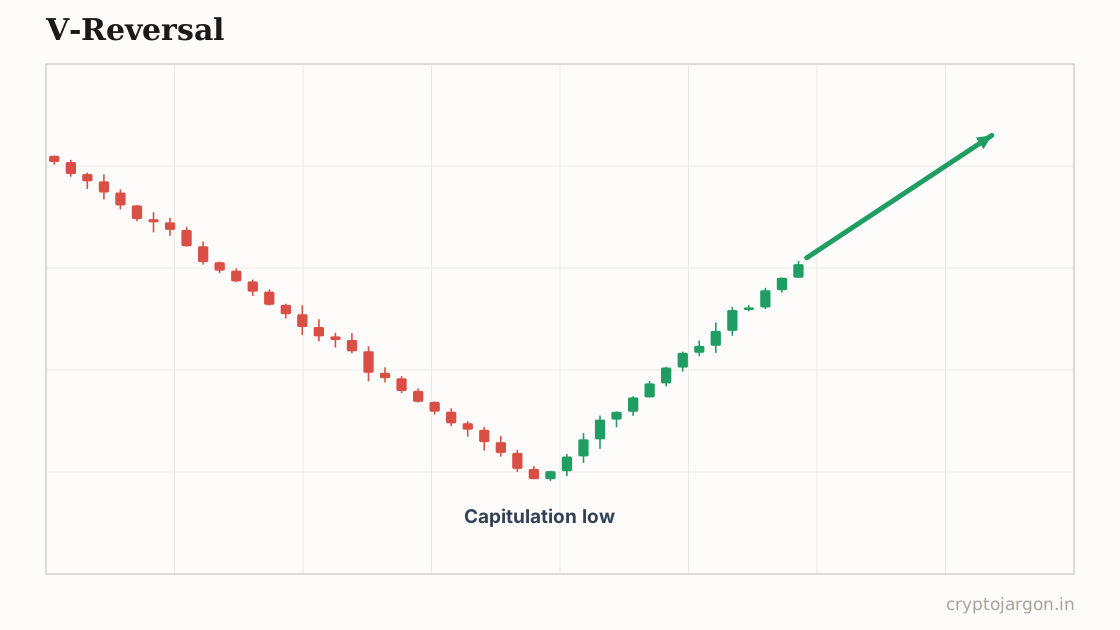
A V-reversal is a sharp reversal pattern where price crashes and rebounds almost immediately at a similar pace, leaving a V-shaped low with no base. It is supposed to signal violent capitulation followed by aggressive repricing — common in crypto around liquidation cascades, but nearly impossible to trade in real time.
"Everyone's got a story about buying the exact bottom of the V — funny how nobody's got the fill screenshot."
The structure
A steep, fast decline — in crypto usually liquidation-driven, with outsized red candles and a volume spike at the low — followed by a recovery at nearly the same slope, leaving no base, no consolidation, just a V. On lower timeframes the low is often a single enormous wick. The defining feature is what's missing: no floor-building, no retest, nothing to lean on. Crypto prints more of these than any legacy market, because leveraged perp positions create cascades of forced selling that have nothing to do with anyone's opinion of value.
Whose orders make the shape
The down-leg of a V usually isn't people deciding to sell — it's liquidation engines force-closing longs into a thinning book, each fill triggering the next stop. That's why it's so fast: nobody is choosing this. The moment the forced flow exhausts, the order book is a vacuum; any real bid reprices the market violently upward, and shorts who chased the low cover into that same thin book, accelerating the right side of the V. The shape is two crowds being forced to transact at the worst possible prices, in both directions, minutes apart.
The conventional trade plan
There's no clean textbook plan here, and pretending otherwise would be lying to you. The workable convention: don't catch the knife; wait for price to reclaim a level that mattered before the crash — the prior range low, a broken support — and enter on the retest of that reclaim, with invalidation below the V's low. The target is conventionally the origin of the move, where the cascade began. The early 'buy the flush' trade exists, but it's an execution game measured in seconds, played against engines.
The trap — what invalidates it. The trap is the half-finished V: a violent bounce that everyone calls the bottom, which then rolls over and retests or breaks the low — the dead-cat sequence. Buying the first big green candle because it looks like the Vs you remember is the retail move; the Vs you remember are the survivors. What confirms: the reclaim of a pre-crash level that holds on retest, funding resetting from extremes, open interest flushed out. What tempts: one heroic candle and a screenshot of someone else's fill. And note that resting limit orders 'under the wick' are a known pool — wicks get revisited to collect them.
What the evidence says
Full honesty: V-reversals barely qualify as a tradeable pattern, because by definition they give no signal until they're mostly over — pattern studies generally require confirmation structure that a V doesn't have. What is well documented in crypto is the mechanics around them: liquidation cascades, thin order books, and violent snap-backs afterwards. Study those mechanics; the letter left on the chart is just the residue.
Tested on our data?
Not this one — it needs a human-drawn line, and a pattern that two traders would draw two different ways can't be backtested honestly. We test the mechanical ones and say so, rather than inventing a number.
Watch the radar for cascade conditions
Related
Part of the pattern library — every pattern with its trap, because the textbook version is the bait.
Crypto Jargon
Live numbers load with JavaScript and refresh every few minutes; the text above is the page at build time.