
Cup and Handle
Patterns · Continuation Patterns
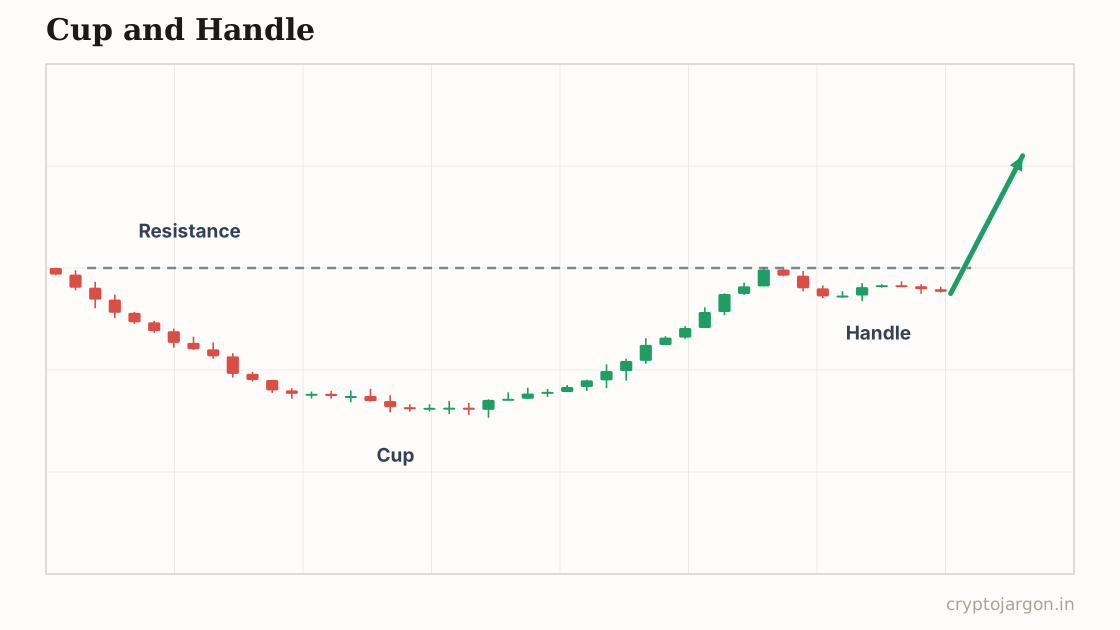
A cup and handle is a bullish continuation pattern: a long rounded base (the cup) that recovers to prior highs, then a shallow pullback (the handle) near resistance. It is supposed to signal accumulation completing, with a breakout above the handle conventionally targeting the depth of the cup projected upward.
"A U-shaped round trip back to the scene of the crime, with one last shakeout at the rim before the actual move."
The structure
The cup is a gradual, rounded decline and recovery — a U, not a V — commonly giving back a third to half of the prior advance before returning to the old high. The handle forms at the rim: a shallow drift lower, shorter and much smaller than the cup, conventionally retracing no more than about a third of the cup's right side. On dailies this takes weeks to months; crypto produces fractal versions intraday. A handle that keeps deepening past the cup's midpoint isn't a handle anymore — it's a failed recovery printing a lower high.
Whose orders make the shape
The cup is overhead supply being digested: everyone who bought the old high and watched it drop is underwater through the whole base, and their selling gets absorbed gradually — that's what the rounded shape is. At the rim, the last of them finally get their money back and sell — 'thank god, out flat' — which is exactly what the handle is: breakeven sellers exiting into resistance. Once they're done, the overhead supply is thin, and the buy stops parked above the rim give the breakout its fuel.
The conventional trade plan
Convention: buy the break above the handle's high, with invalidation at a close below the handle's low — if the breakeven sellers were really done, price shouldn't need to go back down there. The measured target is the cup's depth projected up from the breakout. This is imported equities folklore (O'Neil's growth-stock playbook) and the crypto convention follows it straight, including the preference for volume expanding on the breakout and drying up in the handle.
The trap — what invalidates it. The rim and handle high form one of the most telegraphed buy-stop shelves in charting — the pattern takes weeks to build, so everyone's watched it and everyone's orders sit in the same place. The standard raid: a sweep above the rim that fills the breakout crowd, then a rejection that leaves them holding the top. The handle itself is the other trap: what looks like a polite pullback can quietly become distribution, so respect the depth rule instead of redrawing the lines. What confirms: acceptance above the rim and the old resistance holding as support on the retest. What tempts: an intraday wick over the rim after a long, obvious grind.
What the evidence says
The pattern's reputation rides on equities lore built from hand-picked winners; the losers that looked identical at the rim don't make the books. Rule-based testing struggles with the shape itself — 'rounded' is a judgment call — and finds nothing like the reliability the folklore claims. In crypto specifically, systematic validation is thin to nonexistent.
Tested on our data?
Not this one — it needs a human-drawn line, and a pattern that two traders would draw two different ways can't be backtested honestly. We test the mechanical ones and say so, rather than inventing a number.
Related
Part of the pattern library — every pattern with its trap, because the textbook version is the bait.
Crypto Jargon
Live numbers load with JavaScript and refresh every few minutes; the text above is the page at build time.